25 Wealth-Building Rules That Most People Learn Too Late
Discover 25 proven wealth-building rules inspired by Scott Galloway's The Algebra of Wealth, from compound investing and smart delegation to the psychology of money and long-term financial freedom.
In This Article
The Algebra of Wealth
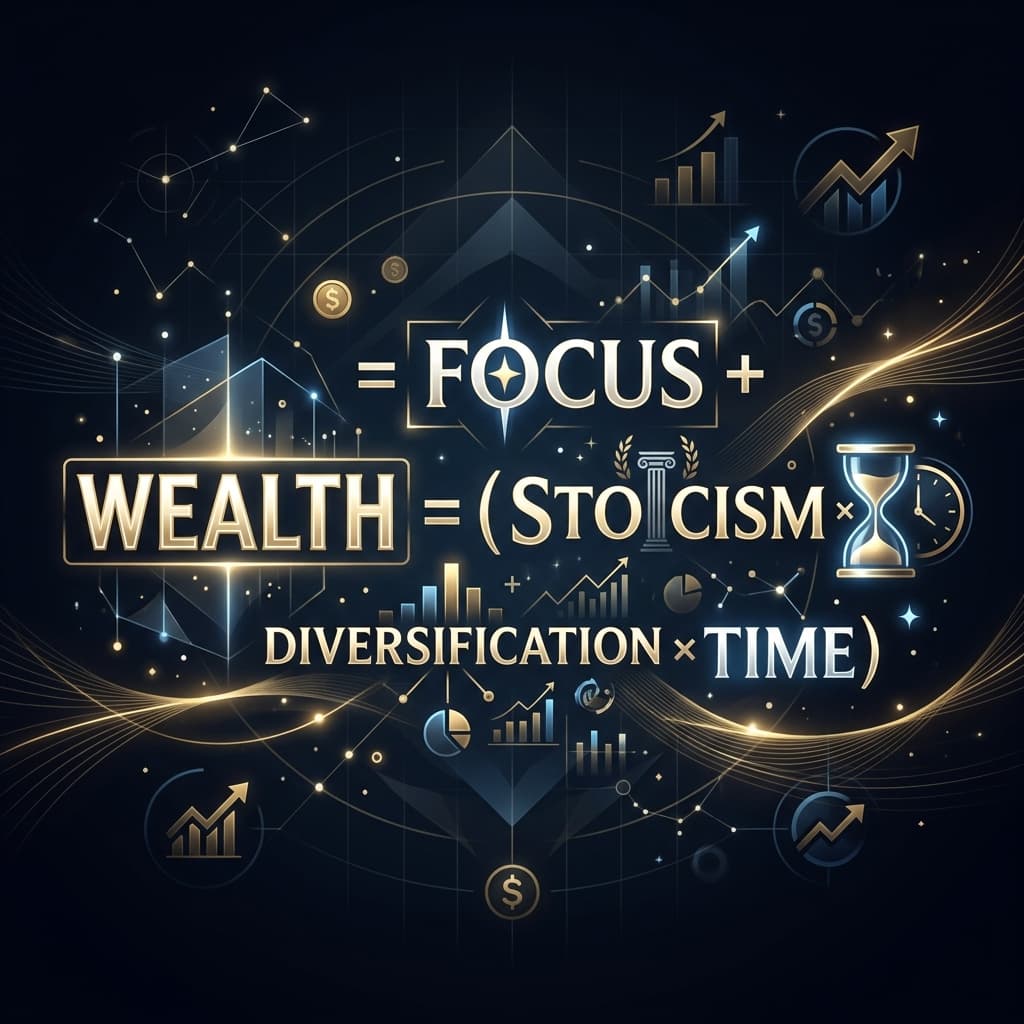
Most people spend decades working hard without accumulating meaningful wealth, not because they lack intelligence or discipline, but because no one ever taught them how the wealth-building game actually works. Scott Galloway's bestselling book, The Algebra of Wealth, lays out a deceptively simple formula: Focus + Stoicism × Diversification × Time. The catch? Three of those variables are multiplied together. If any one of them is zero, the entire formula collapses, regardless of how much you earn or how hard you grind.
Here are 25 rules that wealthy people quietly follow, and that most of us never learn until it's too late.
1. Understand How the Wealthy Actually Use Money
Rich people have significant cash reserves, but they rarely spend them. Instead, they borrow against their assets. Here's why that matters.
Imagine owning $10 million in stock. You haven't sold it, so it hasn't been taxed. Now you want to buy a $2 million home. Rather than selling shares and triggering a tax event, you use your portfolio as collateral for a bank loan. The loan is debt, not income, so it's not taxable. Meanwhile, your assets keep appreciating.
This is the game. Income is taxed at the source. Debt against assets flows freely. You can't play this game with small holdings, but understanding it clarifies the first wealth-building objective: build assets first.
2. Leverage Time as Your Most Powerful Asset
Time in the market beats timing the market, every single time. Consider this: a friend who invests from age 20 to 30, then stops completely, will still end up wealthier than someone who starts at 30 and invests three times as much money over three times as many years.
That's the power of compounding. Money invested early doesn't just grow, it multiplies. Skills developed early compound too. The only thing that never compounds is inaction. Start now, even imperfectly.
3. Choose the Right Industry Before Perfecting Your Craft
You can outwork everyone in a declining industry and still lose. A mediocre professional who joined a fast-growing sector in 2010 built more wealth than a brilliant journalist who joined a dying one the same year, with identical effort and hours.
Before obsessing over your surfboard, pick the right wave. Is your industry expanding or contracting? If you're on the wrong wave, no amount of paddling will carry you to shore.
4. Follow Your Talent, Not Your Passion
"Follow your passion" is advice most often given by people who got rich doing something practical, software, logistics, finance. They romanticized it afterward.
The reality: most people under 26 don't even know what their passion is yet. What they do know, or can discover, is their talent: the thing they do naturally that others find difficult. Master that talent. Get paid well for it. Then pursue passion in your free time.
Steve Jobs loved calligraphy and Eastern philosophy, but he built computers, not a calligraphy studio. He followed his talent. Mastery of your talent is often where passion is born. Get the sequence right.
5. Focus Your Time, Diversify Your Money
These two principles must never be confused or swapped.
Your time and energy should be concentrated on one skill, one craft, one domain, until you reach genuine depth. Your money, however, should never ride on a single bet. Spread it across different asset classes so that no single failure can wipe you out.
The mistake most people make is the exact opposite: they scatter their attention across a job, a side hustle, a social media channel, and a crypto project, doing none well, while simultaneously putting all their savings into one stock. Concentrated time, diversified money. That's the formula.
6. Stop Day Trading
Casino slot machines offer better statistical odds than the average retail trading app. That's not hyperbole, it's documented. The vast majority of people who day trade lose money over any sustained period.
One early win is the trap. It mimics gambling mechanics: intermittent reinforcement that keeps you hooked. The people on the other side of your trades are professional teams with PhDs, Bloomberg terminals, and algorithmic models whose sole purpose is to profit from retail traders like you.
Put that money in low-cost index funds instead. Leave it alone for 20 years. The math wins without the stress.
7. Embrace Imbalance in Your Twenties
Work-life balance in your twenties is largely a myth, or at least, a luxury best deferred. The people who pursue balance at 25 often find themselves with fewer options at 45. Those who grind early tend to earn the freedom to choose later.
Think in phases. Your twenties and thirties are the building phase, foundational work that pays dividends in freedom later. Your forties and fifties become the harvest phase. Most overnight successes are actually the product of 15 to 20 years of invisible, unglamorous effort.
Being temporarily unbalanced isn't failure. It's strategic investment in your future self.
8. Build Wealth During Downturns
Economic crises are the best wealth-building opportunities available to ordinary people. Microsoft and Apple were born during the 1975 recession. Airbnb, Uber, Slack, and WhatsApp all emerged from the wreckage of 2008.
Hard times offer two advantages: assets go on sale, and competition thins out. The investors who buy during fear and panic are the ones who grow wealthy during recovery. Easy markets make people complacent. Difficult markets forge capability.
If things are hard right now, that's precisely when the window is open, before everyone else returns.
9. Treat Your Twenties as a Workshop
Your twenties aren't supposed to be figured out. They're supposed to be experimental. Try different roles, industries, and approaches. Fail at things. Collect data on what actually fits you.
Think of it as a three-phase arc: your twenties are the workshop (experiment and learn); your thirties are for mastery (go deep on what works); your forties and beyond are for harvesting (reap what you've built). The danger is comparing your workshop phase to someone else's harvest phase and feeling behind. You're not, you're just in a different chapter.
10. Know When to Walk Away
"Never give up" is incomplete advice. Every successful person has quit something. The real skill is knowing what and when to quit.
The concept of sunk cost, staying in a failing path because of time already invested, is one of the most expensive psychological traps in wealth-building. The person who made that original decision had less information than you do now. Circumstances change. You're allowed to change with them.
Failing fast means moving on. Failing slowly drains years and resources. A strategic retreat from the wrong path isn't defeat, it's a step forward.
11. Stop Doing Everything Yourself
Every hour you spend on low-value tasks is an hour not spent on high-value ones. Before any task, ask: could someone else do this as well or better than me? If yes, run a simple calculation. What does it cost to delegate? What could you earn with that reclaimed time?
If the second number exceeds the first, delegate. Every time.
Delegation isn't just about employees. It's the neighborhood kid mowing your lawn, a virtual assistant handling your inbox, software automating your bookkeeping, or a grocery delivery service returning two hours to your week. Buy back your time, it's the scarcest resource you have.
12. Show Up in Person, in the Right City
The dream of working from a beach in Bali is appealing but statistically misleading. The highest-paying opportunities, the most influential networks, and the people who can actually alter your career trajectory are concentrated in cities.
And once you're in those cities, show up physically. Research consistently shows that remote workers are promoted less frequently than their in-office counterparts, even when output is identical. Visibility is trust. Trust is opportunity. Informal conversations, shared lunches, and hallway presence compound over time in ways that Zoom squares simply can't replicate.
13. Set Goals You Can Actually Hit
The psychology of goal-setting matters enormously for wealth-building. A savings target set too high doesn't motivate, it demoralizes. Missing it triggers shame, and shame often leads to abandoning the habit entirely.
A better approach: set your savings goal at roughly 70% of what feels right. Hit it consistently. Build the habit of winning. Then gradually raise the bar. Momentum creates discipline; discipline creates wealth. Small, repeated victories outperform ambitious, abandoned ones.
14. Keep Investing as Simple as Possible
The complexity surrounding investing is one of the primary reasons people don't start. But the strategy that beats nearly everything else is almost embarrassingly straightforward:
1. Open an account with a reputable brokerage
2. Invest in low-cost index funds
3. Contribute consistently every month
4. Don't touch it for 20 years
That's it. Research shows that 94% of professional fund managers fail to outperform a basic index fund over a 20-year period. You don't need to beat them. You just need to stay in the game.
15. Organize Your Money Into Three Buckets
Instead of spending first and saving whatever's left — a strategy that reliably produces zero savings — organize your money into three distinct buckets from the moment it arrives.
Bucket 1 — Daily living: Rent, food, transportation. Your largest and most predictable expenses.
Bucket 2 — Near-term reserves: Emergency fund, down payment, upcoming large purchases.
Bucket 3 — Long-term wealth: Retirement accounts, investments, your future financial independence.
Determine the minimum you need for Bucket 1, then split everything above it between Buckets 2 and 3. Even $50 a month into the latter two buckets is how the habit starts.
16. Talk Openly About Money
Musicians discuss technique openly. Athletes compare training methods. Developers share code. Yet money remains oddly taboo, and that silence benefits the people who already have it.
Your employer benefits when you don't know what your colleagues earn. Financial institutions benefit when you don't understand your options. When you talk openly about money, comparing salaries, sharing investment approaches, discussing mistakes, you accelerate your own financial education faster than any book or course.
Find people willing to be honest. Ask uncomfortable questions. Share your own numbers. One candid conversation can be worth thousands of dollars.
17. Treat Financial Health as Physical Health
Financial anxiety isn't just emotionally draining, it has measurable physiological consequences. Studies show that children from lower-income households exhibit higher blood pressure than their wealthier peers at the same age, with the same diet. The only meaningful variable is stress.
Chronic money anxiety operates like undetected high blood pressure: silent, persistent, and damaging. Getting your finances in order isn't just about wealth accumulation. It's about protecting your long-term health.
18. Choose Your Life Partner With Financial Clarity
Your single most consequential financial decision isn't a stock pick, a real estate purchase, or a career move. It's who you marry.
Married couples are statistically about 77% wealthier than single individuals, and net worth tends to increase roughly 16% for each year of marriage. Divorce, on the other hand, destroys approximately 75% of both partners' wealth. And the leading predictor of divorce isn't infidelity, it's money conflict.
If you're already married, have the real money conversation now: values, goals, fears, debts. If you're seriously dating someone, pay attention to how they handle finances. It isn't romantic to discuss, but neither is splitting shared assets in a courtroom.
19. Acknowledge the Role of Luck
How much of your success is skill, and how much is circumstances you didn't choose? Be honest.
The single strongest predictor of long-term financial success is where and when you were born. Someone with your exact abilities, born in a different country or era, has a fundamentally different outcome. That's not capability, that's luck.
Forgetting this makes you dangerous to yourself. Overconfidence leads to inflated risk-taking, dismissal of good advice, and eventual correction. The people who build lasting wealth tend to be the ones who stay genuinely humble about how they got there.
20. Stop Catastrophizing What You Can't Control
The crises keeping you up at night will, statistically, barely register in your memory five years from now. When elderly people are surveyed about their deepest regrets, the most common answer isn't "I failed too much", it's "I wasted too much energy worrying about things that didn't matter."
A useful mental filter: Can you actually do something about this? If yes, act. If no, it isn't a problem, it's a situation. Redirect your energy to what you can influence. Stop fighting forces outside your control.
21. Stop Living in Your Critics' Heads
Replaying an old argument, rehearsing a comeback, fantasizing about proving someone wrong, all of that mental energy is time you're not building anything. Your doubters aren't losing sleep over you. But you're losing sleep over them.
Take whatever genuinely useful feedback exists, discard the rest, and get back to work. The best response to criticism isn't a comeback. It's output.
22. Make Living Well Your Only Motivation
Closely related to the above: if your wealth-building is fueled by a desire to prove someone wrong, you're still letting them steer. That's a subtler trap one that can persist for years without being recognized.
The reframe that unlocks real freedom: the best revenge is simply living a better life. Not better than them just better, fuller, and more aligned with what you actually want. When you get there, the critics become irrelevant by default.
23. Use Mortality as a Decision Filter
Memento mori "remember that you will die" is one of the most practically useful mental frameworks available. It cuts through the noise of short-term anxiety and forces clarity on what actually matters.
Before any major decision, ask: when you're 85 years old, looking back, will you regret not doing this? If the answer is yes, the path forward is clear. Death puts everything in proper proportion. Use that perspective before you need to.
24. Measure Spending in Time, Not Dollars
Scott Galloway bought a private jet not for comfort, but because he calculated that commercial travel over 10 years would cost him roughly four months with his sons during their childhood. At $12 million over a decade, the jet's true cost was four months of irreplaceable time. To him, that was the easier choice.
You likely won't buy a jet, but the principle scales to any decision. A $50 dinner with an aging parent that becomes a genuine memory may be the best investment you ever make. Before spending money, ask what you're trading in time and experience, not just dollars.
25. Remember That Money Is the Ink, Not the Story
At some point, your bank balance will stop moving the needle on your happiness. Research consistently confirms this: the difference between financial scarcity and financial security is life-altering. But beyond a certain threshold, additional wealth produces diminishing emotional returns.
Build wealth, not for the number itself, but for what it unlocks: security, options, time, and the freedom to protect the people you love. The money is the ink. What you write with it, the relationships, the experiences, the choices, that's the story.
Don't get so focused on accumulating the ink that you forget to write.
Final Thought: Behavior Drives Wealth More Than Knowledge
Most of the rules above aren't purely mathematical. They're psychological, about how you think, what you fear, and the invisible patterns your brain defaults to under pressure. Wealth-building is roughly 95% behavioral and only 5% technical knowledge.
Understanding compound interest doesn't make you wealthy. Consistently investing, avoiding self-destructive financial habits, and playing the long game does. The gap between knowing and doing is where most people's wealth disappears.
Now you know the rules. The next move is yours.
Take Action
Reading is great.
Tracking is better.
Apply what you've learned with WiseCash — the financial dashboard built for people serious about their money.
Start Tracking Free →Keep Reading
Related Articles

How to Build Multiple Income Streams (Without Burning Out)
One income source is a vulnerability. Here's how to build multiple revenue streams, from side hustles to passive income, while keeping your sanity intact.

7 Financial Habits of Wealthy People (That Have Nothing to Do With Luck)
Wealth isn't built by lottery winners. It's built by people with boring, consistent habits. Here are the 7 daily practices that separate the wealthy from everyone else.

The 50/30/20 Rule: The Simplest Budget Framework That Actually Works
Stop overcomplicating your budget. The 50/30/20 rule gives you a dead-simple framework to split your income into needs, wants, and savings so you can actually stick with it.