7 Financial Habits of Wealthy People (That Have Nothing to Do With Luck)
Wealth isn't built by lottery winners. It's built by people with boring, consistent habits. Here are the 7 daily practices that separate the wealthy from everyone else.

In This Article
Wealth Is a System, Not an Event
When people see someone wealthy, they assume there was a moment. A big break, a lucky investment, a windfall. For 88% of millionaires, that moment never existed. According to the National Study of Millionaires by Ramsey Solutions, the vast majority built wealth gradually through consistent behavior.
No trust funds. No lottery tickets. No crypto moonshots. Just a set of habits practiced so consistently they became automatic. The good news? Every single one of these habits is learnable. The bad news? None of them are exciting. But that's kind of the point.
Habit 1: They Track Everything
The number one habit across nearly every study on wealth building is this: wealthy people know exactly where their money goes. Not approximately. Not 'I think I spend about...' They know.
This doesn't mean they obsessively log every coffee. It means they have systems that give them clarity, like budgeting apps, monthly reviews, and financial dashboards. They treat personal finances with the same rigor a CEO applies to a P&L statement.
If you can't tell me within $200 how much you spent last month on food, transportation, or entertainment, you're flying blind. And you can't optimize what you can't see.
Pro Tip
This is literally why WiseCash exists. Automatic categorization, spending insights, and budget health scores give you CEO-level visibility into your personal finances without CEO-level effort.
Habit 2: They Pay Themselves First
Most people save what's left after spending. Wealthy people spend what's left after saving. The difference sounds subtle, but it's everything.
By automating savings and investments on payday, before bills, before groceries, before anything else, you reverse the entire psychology of money. You adapt to living on less without ever feeling the pinch.
The benchmark varies, but most wealth-builders save 20-40% of their income. That sounds extreme until you realize they've structured their lives to make it painless through automation and lifestyle choices.
Habit 3: They Avoid Lifestyle Inflation
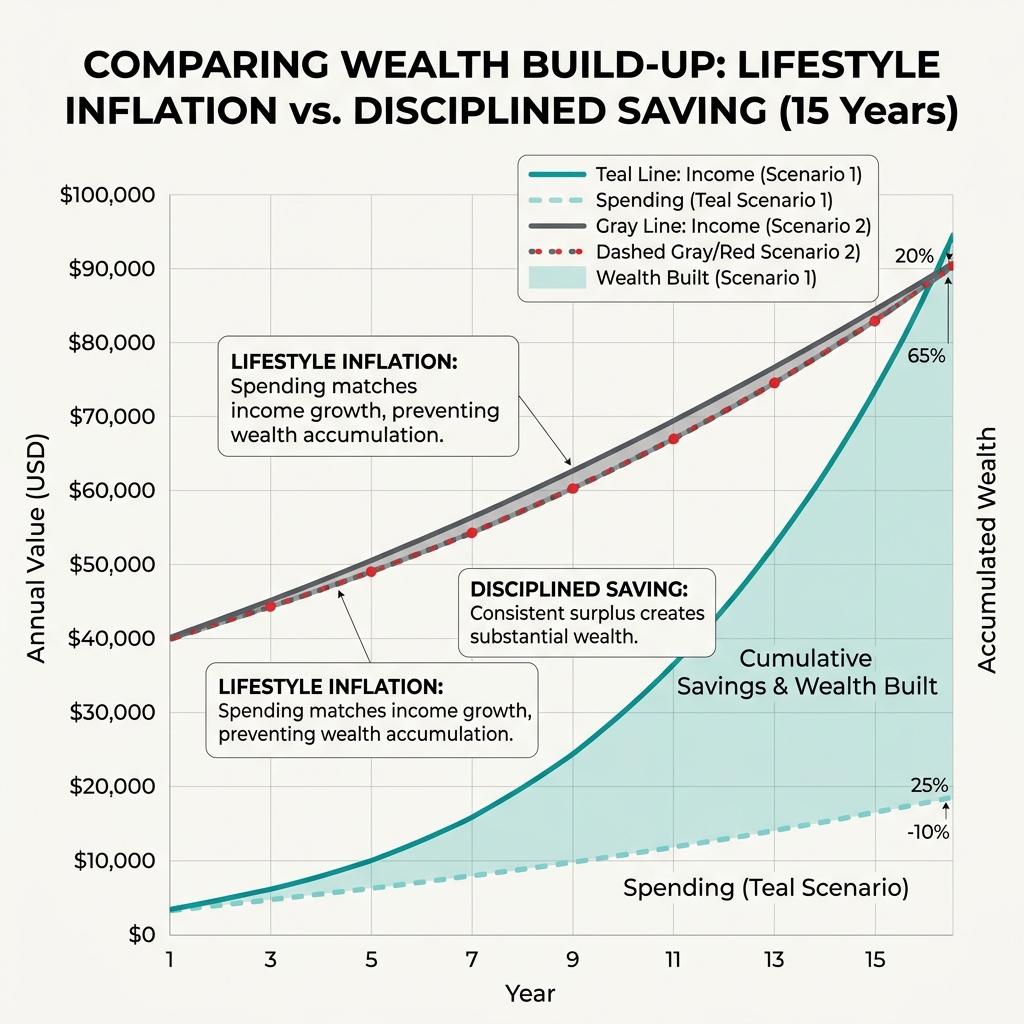
Get a raise? Most people upgrade their car, apartment, and wardrobe within months. Their expenses rise to meet their income, and their savings rate stays flat. This is called lifestyle inflation, and it's the silent wealth killer.
Wealthy people do something counterintuitive: when their income goes up, their lifestyle stays roughly the same. The gap between earning and spending widens, and that gap is where wealth lives.
This doesn't mean living like a monk. It means being intentional. Upgrade one thing that genuinely improves your life. Bank the rest. A $10,000 raise invested at 10% for 20 years becomes $67,000. A $10,000 raise spent on a slightly nicer car becomes a depreciating asset and higher insurance premiums.
Habit 4: They Invest Consistently, Not Cleverly
The wealthiest investors aren't the smartest stock pickers. They're the most consistent ones. Warren Buffett, arguably the most famous investor alive, has recommended index funds for regular people for decades.
Dollar-cost averaging into broad market index funds isn't sexy. It won't make you rich overnight. But it will almost certainly make you wealthy over 20-30 years. The key phrase is 'almost certainly,' and in investing, those are the best odds you'll ever get.
Every market crash produces two groups: those who panic and sell (locking in losses) and those who keep buying (getting stocks on sale). Group two is where the millionaires come from.
Habit 5: They Set Goals With Deadlines
Saying 'I want to save more' is a wish. Saying 'I will save $15,000 for an emergency fund by December 2026' is a goal. Wealthy people think in specific numbers and specific timelines.
This isn't just motivational poster advice. It's how the brain works. Specific goals activate the reticular activating system (RAS) in your brain, which starts filtering information to help you notice opportunities and stay focused.
Break big goals into monthly milestones. $15,000 in 12 months is $1,250/month. That's a number you can plan around, track, and actually hit.
Pro Tip
Set your financial goals in WiseCash with target dates and amounts. The app calculates your required monthly savings and tracks your velocity so you always know if you're on pace.
Habit 6: They Learn Continuously
Tom Corley studied the habits of 233 wealthy individuals over five years. One finding stood out: 88% read educational material for at least 30 minutes daily. Not social media scrolls. Actual books, articles, and research about finance, business, and personal development.
Financial literacy isn't taught in schools, so it has to be self-taught. The difference between someone who understands compound interest, tax-advantaged accounts, and asset allocation versus someone who doesn't is often hundreds of thousands of dollars over a lifetime.
You're reading this article right now. That's the habit in action. Keep going.
Habit 7: They Protect Their Downside
Wealthy people aren't just good at making money. They're obsessive about not losing it. Insurance, emergency funds, diversification, estate planning. Boring stuff that prevents catastrophic losses.
A single medical emergency without insurance can wipe out a decade of savings. A lawsuit without an umbrella policy can take your house. An unexpected death without life insurance can devastate a family's finances for generations.
Protecting what you've built isn't paranoia. It's the same risk management that every successful business practices. Your personal finances deserve the same protection.
Frequently Asked Questions
What financial habits do millionaires have in common?
Research shows most millionaires share these habits: they track their spending consistently, save 20-40% of income automatically, avoid lifestyle inflation, invest in low-cost index funds, set specific financial goals with deadlines, read about finance daily, and maintain strong financial protection (insurance, emergency funds, diversification).
How can I start building wealth with a low income?
Start by tracking every dollar you spend, building a $1,000 emergency fund, and automating even small savings ($25-50/month). Focus on increasing your income through skill development or side work. The habits matter more than the dollar amounts. People who build the system early scale it as their income grows.
Take Action
Reading is great.
Tracking is better.
Apply what you've learned with WiseCash — the financial dashboard built for people serious about their money.
Start Tracking Free →Keep Reading
Related Articles

How to Build Multiple Income Streams (Without Burning Out)
One income source is a vulnerability. Here's how to build multiple revenue streams, from side hustles to passive income, while keeping your sanity intact.

25 Wealth-Building Rules That Most People Learn Too Late
Discover 25 proven wealth-building rules inspired by Scott Galloway's The Algebra of Wealth, from compound investing and smart delegation to the psychology of money and long-term financial freedom.

The 50/30/20 Rule: The Simplest Budget Framework That Actually Works
Stop overcomplicating your budget. The 50/30/20 rule gives you a dead-simple framework to split your income into needs, wants, and savings so you can actually stick with it.