A No-BS Beginner's Guide to Investing (Start With $100)
Investing isn't just for Wall Street bros. Here's how to start building real wealth with index funds and ETFs, even if you only have $100 to spare.

In This Article
The Biggest Myth About Investing: You Need a Lot of Money
If you think investing is something you'll 'get to eventually' once you make more money, you're leaving years of compound growth on the table. The best time to start was 10 years ago. The second-best time is today, with whatever you have.
Thanks to fractional shares and zero-commission brokerages, you can literally buy a piece of the S&P 500 for $1. The barrier to entry has never been lower. What's actually stopping most people isn't money. It's overwhelm.
So let's strip away the jargon, ignore the day-trading noise, and talk about the one investing strategy that has consistently built wealth for regular people over the last century.
Index Funds: The Only Investment Most People Need
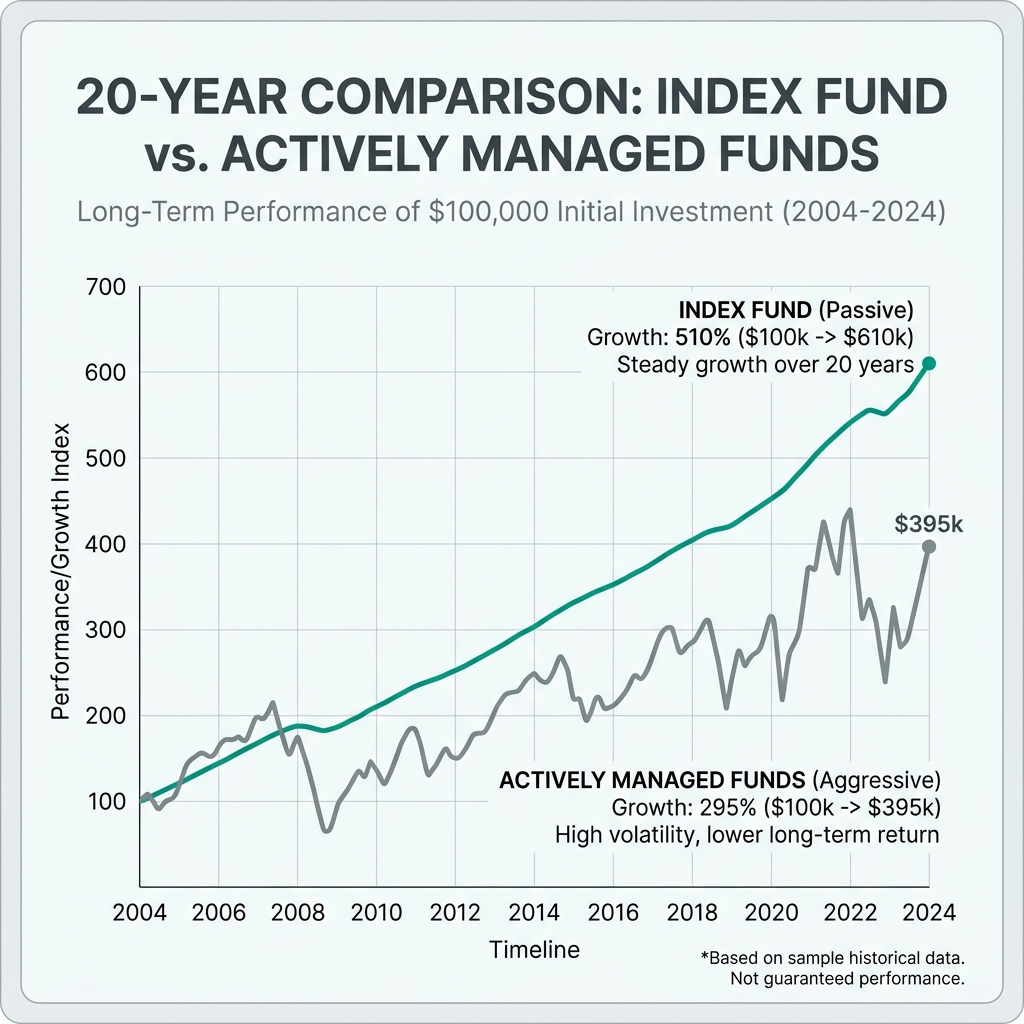
Here's a stat that should make you feel better about keeping things simple: over any 15-year period in history, a basic S&P 500 index fund has outperformed roughly 90% of professionally managed hedge funds. Ninety percent.
An index fund is just a basket of stocks that tracks a market index. When you buy a share of an S&P 500 index fund, you're buying a tiny piece of the 500 largest U.S. companies. Apple, Microsoft, Amazon, all of them. Instant diversification.
The cost is absurdly low. Vanguard's VOO charges 0.03% per year. That's 30 cents for every $1,000 invested. Compare that to the 1-2% fees of actively managed funds, and it's not even close.
- VOO / VTI (Vanguard): S&P 500 / Total US Market
- SPY (State Street): The original S&P 500 ETF
- FXAIX (Fidelity): Zero-fee S&P 500 index fund
- VT (Vanguard): Total World Stock for global diversification
The Power of Compound Interest (With Real Numbers)
Albert Einstein allegedly called compound interest the eighth wonder of the world. Whether he actually said that is debatable, but the math isn't.
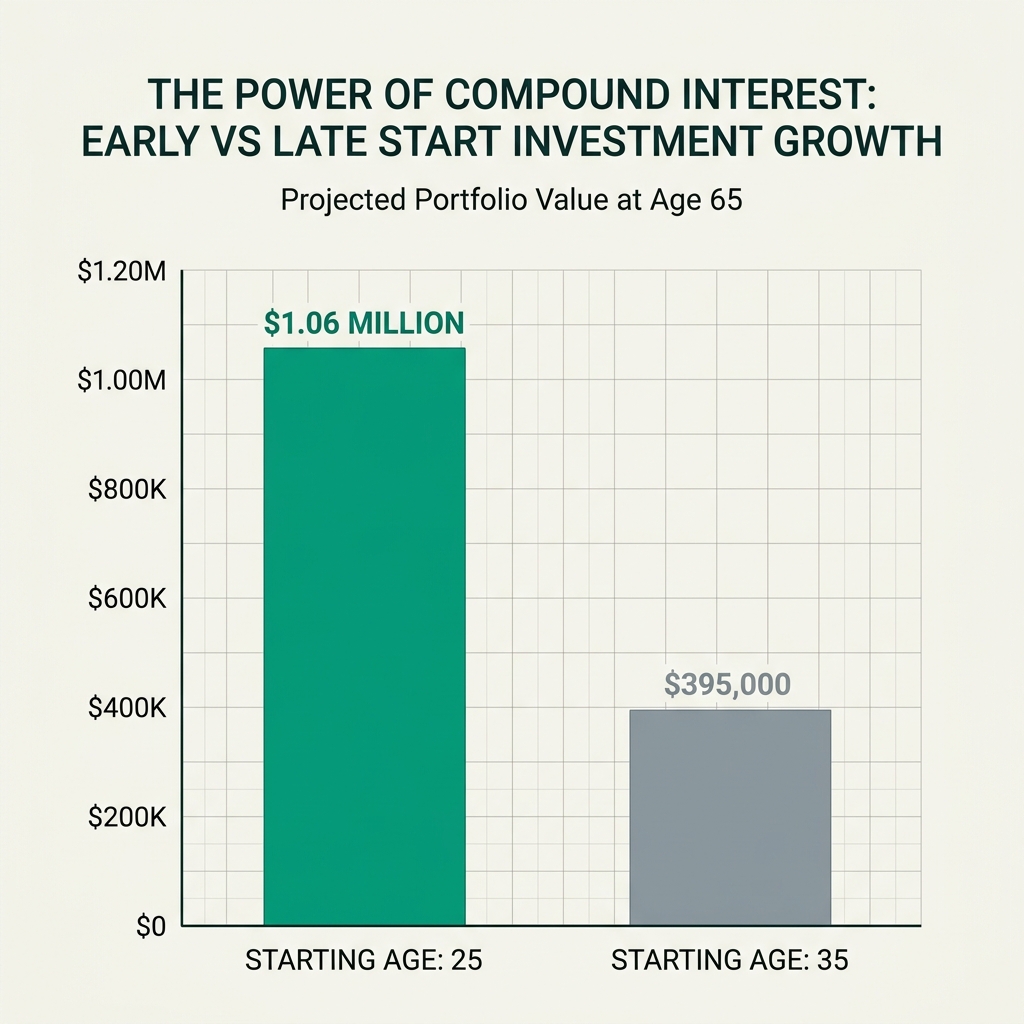
If you invest $200/month starting at age 25 with an average 10% annual return (the S&P 500's historical average), by age 65 you'd have roughly $1.06 million. Your total contributions? Just $96,000. The other $964,000 is pure compound growth.
Start the same $200/month at age 35? You'd end up with about $395,000. That 10-year delay costs you over $650,000. Time in the market beats everything.
Pro Tip
The math doesn't lie: consistency beats timing. Don't wait for the 'perfect' moment to invest because there isn't one. Dollar-cost averaging into an index fund monthly is the closest thing to a cheat code in personal finance.
How to Actually Open an Account and Buy Your First Fund
Step one: open a brokerage account. Fidelity, Charles Schwab, and Vanguard are the big three. All have zero-commission trades and no account minimums. The process takes about 15 minutes and is entirely online.
Step two: decide on account type. If your employer offers a 401(k) with a match, max out the match first. It's literally free money. After that, open a Roth IRA (contributions grow tax-free). Only after both of those are maxed should you consider a regular taxable brokerage account.
Step three: pick one index fund (VTI or VOO are great starting points), set up a recurring monthly purchase, and then do the hardest part. Leave it alone. Don't check it daily. Don't panic when the market dips. Just keep buying.
- Get your employer's 401(k) match first (free 50-100% return)
- Open a Roth IRA for tax-free growth ($7,000/year limit in 2026)
- Choose ONE broad index fund to start (VTI, VOO, or FXAIX)
- Set up automatic monthly investments and don't touch it
- Only use a taxable brokerage after maxing tax-advantaged accounts
What NOT to Do as a Beginner Investor
Don't day trade. Don't buy individual stocks based on Reddit tips. Don't try to time the market. Don't invest money you'll need in the next 5 years. Don't panic sell during a downturn.
Every single one of these mistakes is driven by the same thing: emotions. The entire point of index fund investing is to remove emotion from the equation. You buy consistently, you hold for decades, and you let math do the heavy lifting.
The stock market will crash at some point while you're invested. It always does, and it always recovers. The people who get rich are the ones who don't sell at the bottom.
Pro Tip
Use WiseCash's net worth tracking to see your investments grow alongside your savings goals. Having the full picture keeps you motivated during market dips.
Frequently Asked Questions
How much money do I need to start investing?
You can start investing with as little as $1 thanks to fractional shares offered by most major brokerages. Many platforms like Fidelity and Schwab have no account minimums. The important thing is to start early and invest consistently, not to wait until you have a large sum.
What is the best investment for beginners?
A broad-market index fund like VTI (Vanguard Total Stock Market) or VOO (Vanguard S&P 500) is widely considered the best starting point for beginners. These funds offer instant diversification across hundreds of companies with extremely low fees (0.03% annually).
Is it better to invest in a Roth IRA or a 401(k)?
Do both if possible. First, contribute enough to your 401(k) to get your employer's full match (it's free money). Then max out a Roth IRA ($7,000/year in 2026) for tax-free growth. After that, go back to your 401(k) or open a taxable brokerage account.
Take Action
Reading is great.
Tracking is better.
Apply what you've learned with WiseCash — the financial dashboard built for people serious about their money.
Start Tracking Free →Keep Reading
Related Articles

How to Build Multiple Income Streams (Without Burning Out)
One income source is a vulnerability. Here's how to build multiple revenue streams, from side hustles to passive income, while keeping your sanity intact.
The 50/30/20 Rule: The Simplest Budget Framework That Actually Works
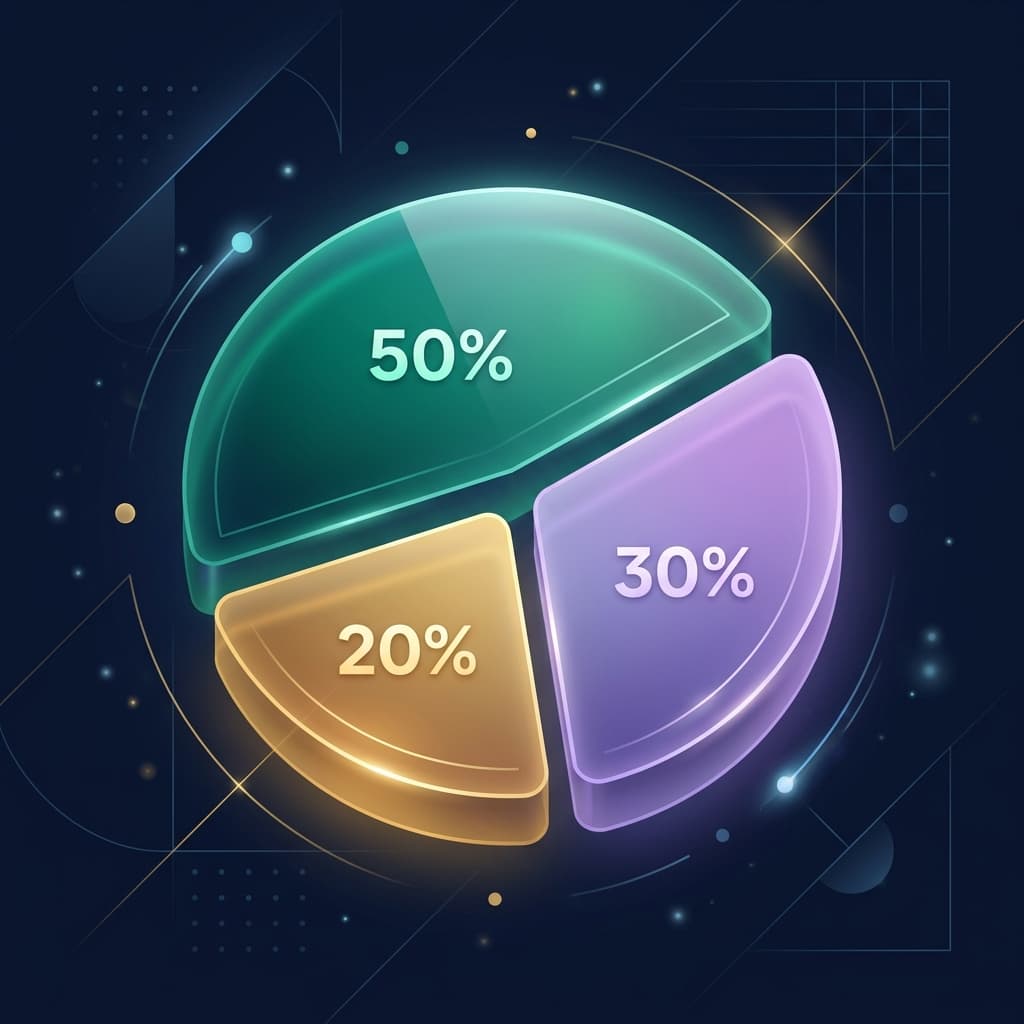
Stop overcomplicating your budget. The 50/30/20 rule gives you a dead-simple framework to split your income into needs, wants, and savings so you can actually stick with it.

Snowball vs. Avalanche: The Two Best Strategies to Crush Your Debt
Drowning in debt? Two proven methods can get you out. Here's an honest comparison of the Snowball and Avalanche strategies, and which one will actually work for you.